
HXLS 62 Campus
A Campus Designed For Curious Young Minds
Our 11.3-acre, digitally enabled campus has been thoughtfully designed to inspire curiosity, creativity, and exploration. With over 100 square feet of learning space per child, the campus provides an environment where students have the freedom to discover, collaborate, and grow.
Purposefully planned to support experiential learning, the campus features spacious, technology-enabled classrooms, specialised laboratories, makerspaces, resource rooms, a well-curated library and resource centre, and a versatile multipurpose hall. Expansive outdoor spaces, dedicated sports fields, and multiple courts for a range of sporting disciplines encourage physical wellbeing alongside academic growth, while the eco-friendly campus nurtures a deep connection with nature.
Every space at Heritage has been designed to enrich the learning experience and empower young minds to thrive.


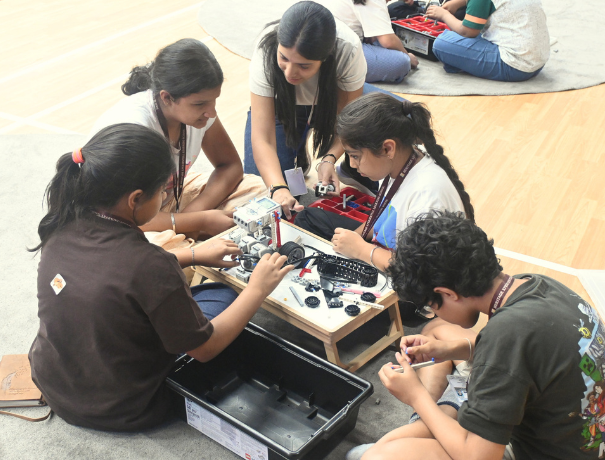
Education Beyond Traditional Classrooms
Our pedagogy is rooted in the belief that children learn best through meaningful experiences. Students engage in hands-on learning that sparks curiosity, followed by reflection and inquiry to deepen understanding. Through dialogue and collaboration, they explore diverse perspectives, ask thoughtful questions, and connect ideas. This cycle of experience, reflection, dialogue, and understanding enables learners to think independently, apply their knowledge with confidence, and develop skills that extend far beyond the classroom.
Experiential Learning
Hands-on inquiry and project-based learning encourage deeper understanding and curiosity.
Social Emotional Learning
Empathy, mindfulness, collaboration, and emotional awareness are embedded into everyday learning.
Innovation & Creativity
Makerspaces, interdisciplinary exploration, and creative problem-solving shape future-ready learners.
Holistic Growth
Balanced focus on academics, sports, arts, performance, and emotional development.

Every Child Matters
Social emotional learning is woven into classroom culture, relationships, and everyday experiences.
Building Emotionally Intelligent Learners
Education is about preparing children not just for academic success, but for life. Our learning philosophy focuses on nurturing joyful, resilient, self-aware, and socially responsible individuals who are equipped to navigate an increasingly complex world with confidence and compassion.
Guided by our Human Framework™, students develop the skills to understand themselves and others, embrace diverse perspectives, manage emotions, build meaningful relationships, and make responsible choices. By proactively embedding social and emotional learning into everyday experiences, we help children grow into mindful individuals who thrive academically, emotionally, and socially.
Mindful Classrooms
Safe and emotionally supportive spaces that encourage student voice and participation.
Collaborative Learning
Team-based inquiry and peer learning build communication and interpersonal skills.
Reflection & Growth
Students are encouraged to reflect, express themselves, and grow with confidence.
Three Teachers
We recognize parents/guardians as the first teacher, classroom educators as the second, and the environment as the third teacher.

We believe that parents are a child’s first teachers, and meaningful learning happens when schools and families work together. At HXLS, parents are valued partners who actively contribute to the life of the school through open communication, collaborative decision-making, and shared experiences. Through regular interactions, workshops, orientations, and volunteering opportunities, we nurture a strong home-school partnership that enriches every child’s learning journey.
Our Parent Partnership Group (PPG) serves as a vital platform for parent voices, fostering dialogue and strengthening the school community. Beyond the classroom, parents also lead a vibrant range of community initiatives from book clubs, wellness sessions, and sports activities to creative and cultural events creating opportunities for parents to connect, learn, and grow together.

The Heritage teacher is the spark that ignites the desire of ‘Learning to Learn’. Promoting a learning culture that is inquiry-driven begins with teachers who then translate it to listening to all points of view of students, working productively with different perspectives and engaging the disengaged.
Progressive workshops, study missions and the Teacher Empowerment Programmes provide our faculty with the tools to deliver refreshing flexibility and responsiveness to a child’s world and changing needs.
To ensure that they are always up to date and have access to innovative techniques of educating students, our teachers go through extensive training and curriculum research of as many as 300 hours per year. Fifty per cent of this training is led by international facilitators, thought leaders or experts. An in-house team of 18 instructional coaches and curriculum designers work continuously with the teachers inside and outside the classroom to help them hone their practice towards realising their potential.
In addition, teachers are encouraged to enhance their skills and learning by attending study trips, retreats, workshops and other training programmes.

We believe that learning is shaped not only by teachers and experiences, but also by the environment itself. Designed as the ‘Third Teacher’, our learning spaces inspire curiosity, encourage collaboration, and foster independence. Every classroom, studio, and shared space is intentionally created to empower students to explore, question, create, and take ownership of their learning.
Learning Overview
Expeditionary learning lies at the heart of our inter-disciplinary, project-based learning methodology. Each expedition (or project) begins by presenting students with a pertinent, real-life problem or issue. Students perform primary and secondary research on various aspects of the problem, gather and analyse information, interact with experts to learn more, collaborate and brainstorm to find possible solutions to the problem – all within the learning by doing framework. The solution is reviewed, evaluated against the goals of the expedition, and its efficacy tested. A project also brings experts into the classroom, takes students into the field, and engages students in real world learning experiences.
Expeditions by their very nature are inter-disciplinary and focus on developing the project management skills, research skills and data presentation skills in different inter-related areas. Through the process of in-depth investigation, students imbibe habits of deep and critical thinking, inquiry, team-work, respect for others’ perspectives, and a desire to resolve real-life issues in the context of the community. Simultaneously, skills such as numeracy, literacy and subject knowledge are enhanced as each expedition is embedded in the school/grade curricula. Expeditions by their very nature are inter-disciplinary and focus on developing the following skills in different inter-related areas.

Sensory & Spiralled Learning
Indoor & Outdoor Spaces Designed For Exploration

Collaborative Classrooms
Flexible and interactive spaces that support inquiry-led learning.

Makerspace
Hands-on innovation and design thinking experiences.

Visual & Performing Arts
Creative spaces for expression through art, music, dance, and theatre.

Outdoor Play Area
Purposefully designed play and sports areas that encourage exploration, collaboration, and active learning.
From the Principal’s Desk
“The function of education is to teach one to think intensively and to think critically.” — Martin Luther King Jr.
There is something deeply extraordinary about watching a child learn the moment a question leads to a discovery, a familiar idea is seen differently, or a student finds the courage to attempt something that once seemed beyond reach. These moments of curiosity, wonder and realisation lie at the heart of education. They are the moments that shape who our children become.
We believe education must prepare young people not merely to succeed in the world as it exists, but to understand it, question it and contribute meaningfully to its future. Learning, therefore, cannot be confined to textbooks, classrooms or examinations. It must emerge from experience, inquiry, collaboration, reflection and engagement with the world around us.
Our approach seeks to nurture the whole child. Academic rigour sits alongside creativity, sport, the arts and opportunities to explore beyond the school. We encourage students to ask difficult questions, think independently, embrace uncertainty and learn from both success and failure. Most importantly, we want them to develop confidence in their own ideas, while having the humility to listen, reconsider and learn from others.
Yet education is about more than knowledge and skills. It is about developing the values that give knowledge purpose. We want our students to grow into thoughtful, compassionate human beings young people who understand empathy, inclusion, integrity, responsibility and respect. In a rapidly changing world, these values will matter as much as any qualification they earn.
The strength of a school lies in its people. At Heritage, our teachers are facilitators, mentors, co-learners and guides. They create the conditions in which children can wonder, experiment, make connections and discover their own capacities. Their commitment to continually learning and evolving keeps our classrooms alive, relevant and responsive to every learner.
Equally important is the partnership between the school, families and the wider community. A child’s education is enriched when we share a common commitment to nurturing curiosity, character and purpose. We value this partnership deeply and believe that a strong, trusting community gives our children the confidence to grow.
As I look ahead, my aspiration is to build on Heritage’s strong foundations while continuing to create an environment where every learner feels seen, challenged and inspired. We must remain willing to examine our practices, embrace new possibilities and continually ask what education should mean for the world our children will inherit.
If we can send our students into that world with enquiring minds, compassionate hearts, the courage to think independently and the responsibility to make a difference, we will have done something truly worthwhile.
Dr. MONA KHANNA
Principal
Heritage Xperiential Learning school

Important Updates & Campus Information
Upcoming Events
- 2nd July — School Reopen
- 9th July — SEL Workshop
- 11th July — Information Session
- 18th July — Open House
- 24th July — Math Workshop
- 25th July — Open House
School Calendar
Access academic schedules, holiday lists, assessment timelines, and announcements.
Transportation
Safe and reliable transport support with GPS-enabled school buses and route assistance.
Experience Life At HXLS Sector 62
Explore the classrooms, learning culture, collaborative spaces, and everyday experiences that define life at HXLS.
Begin Your HXLS Journey
Admissions are open for Nursery to Grade 12. Explore an experiential learning environment designed to nurture confident, creative, and future-ready learners.
Connect With Us
Campus Address
Heritage Xperiential Learning School – Sec 62 Sector 62, Gurugram, Haryana 122011
Phone
Reception: 0124 – 2855124/25/26, +91 98107 87793 (8:00 am to 4:30 pm)
Admission: 9810539036 (8:00 am to 4:00 pm)
For General Information: info@ggn.hxls.org
For Nursery Admission: nursery.admission@ggn.hxls.org
For Non-Nursery Admission: admission@ggn.hxls.org