
Experiential Schools in Gurgaon: Why HXLS Has Been a Pioneer in Experiential Education
Many school prospectuses today use the word experiential somewhere in their messaging. It has become a bit like the word organic on a food label, present widely, yet meaning something specific in only a fraction of cases.
That is not a criticism of the idea itself. Experiential learning, done properly, is one of the more meaningful shifts in how children are taught. It is a criticism of how loosely the word gets used, which leaves parents with very little way to tell a genuine approach from a marketing choice.
This piece is an attempt to actually define the term, and to explain, plainly, what it looks like when a school takes it seriously rather than treating it as a slogan.
What Experiential Education Actually Means
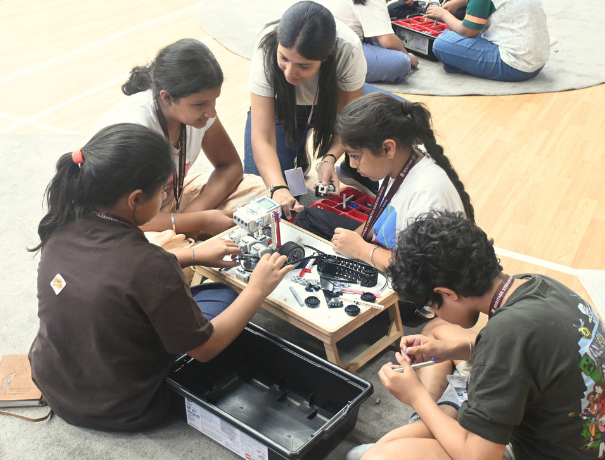
At its core, experiential learning is built on a simple premise, children understand and retain far more when they arrive at knowledge through doing, questioning, and reflecting, than when they receive it passively through lecture and repetition. A child who builds a model to understand a scientific principle is likely to remember that principle years later in a way a child who memorised the definition may not.
This does not mean structure disappears, or that content becomes optional. A genuinely experiential classroom still covers the syllabus in full. What changes is the path children take to get there, and how much of the thinking is done by the student rather than handed to them already finished.
Why This Matters More Now Than It Used To
The case for experiential learning has grown stronger for a fairly practical reason, the world children are entering rewards flexible thinking and genuine problem solving far more than it rewards the ability to recall information on demand. Information itself has become abundant and instantly accessible. What has become scarce, and valuable, is the ability to reason with it, question it, and apply it to problems that do not come with a clean answer key.
Among the schools in Gurgaon that have taken this shift seriously, the changes tend to run deeper than the classroom decor. They show up in how questions are handled, how mistakes are treated, and how much of the school day is spent on genuine inquiry rather than passive absorption.
How to Tell the Difference on a Campus Visit
Since the word is used so widely, it helps to know what to actually look for. Ask what a typical lesson looks like on any given day, not the showcase day reserved for prospective parents. Ask how a wrong answer is handled in class, whether it is treated as a mistake to correct quickly or a starting point for a deeper conversation. Ask how much of a child’s day involves making, building, or investigating something, versus listening and copying notes.
The answers reveal more than any brochure will. A school that is genuinely experiential tends to have teachers who can describe, in concrete detail, how a recent lesson unfolded and what students discovered on their own. A school using the word loosely will often default to describing facilities rather than pedagogy.
Where HXLS Fits Into This
Heritage Xperiential Learning School was built around this idea from the outset, not added as a feature later. The name itself signals the intent, experiential learning is not one strand of the programme, it is the organising principle behind how every subject is taught, from early years through the senior school.
This shows up in how Heritage approaches its academic offering as well. Among the best CBSE schools in Gurgaon, Heritage holds firmly to CBSE’s structure and rigour while insisting that the how of teaching matters as much as the what, students are expected to question, build, and reflect, not simply absorb and recall in preparation for an exam.
The result is a school that sits comfortably among the top schools in Gurgaon on conventional measures, results, reputation, outcomes, while remaining genuinely distinct in what actually happens inside its classrooms day to day. That distinction is not incidental. That distinction is not incidental. Experiential learning has been central to the school’s philosophy since its inception.
What This Looks Like for a Child, Practically
A student at a genuinely experiential school spends less time copying notes from a board and more time working through problems that do not have an obvious first step. They are asked to defend their reasoning, not just state a conclusion. They encounter failure regularly, in a low stakes way, and are taught to treat it as information rather than as something to avoid at all costs.
Over years, this builds a kind of confidence that is different from exam confidence, a comfort with uncertainty, and a habit of asking good questions rather than waiting for good answers to be handed over. It is a harder thing to measure than a test score, and arguably a more important one.
Frequently Asked Questions
Is experiential learning the same as unstructured or informal education?
No. A genuinely experiential classroom still follows a full curriculum and covers all required content, the difference lies in how students arrive at understanding, through inquiry and application rather than passive recall.
Does experiential education work alongside CBSE?
Yes. CBSE sets the content and examination structure, while the teaching approach within that structure can still be genuinely experiential, which is the model Heritage follows.
How can parents verify a school’s experiential approach is genuine rather than just marketing language?
Ask specific questions during a campus visit about how a recent lesson unfolded, how mistakes are handled in class, and how much of a typical day involves active student work versus passive instruction.
Is this approach only relevant for younger children?
No. Experiential methods apply across all year levels, though what they look like in practice shifts significantly from early years exploration to structured research and inquiry projects in senior school.
Conclusion
The word experiential will likely keep appearing on every school website in the city, which makes it a parent’s job to look past the word and ask what is actually happening in the classroom. That question, more than any label, is what separates a school that has built its identity around genuine learning from one that has simply adopted the language of it.
If this approach resonates with what you want for your child, you can begin your CBSE admission in Gurgaon enquiry with Heritage’s admissions team, who can walk you through what this looks like at every stage of a child’s schooling.
Latest Posts

School Admission in Gurgaon: Complete Guide for Parents (2026)
03 August, 2026
CBSE Schools in Gurgaon vs Experiential Schools: What Parents Should…
30 July, 2026
Nursery Admissions Gurgaon: Everything You Need to Know Before Applying
27 July, 2026
Why Heritage Xperiential Learning School is Among the Best Schools…
23 July, 2026
Best Schools in Gurgaon – CBSE vs IB: Which is…
18 June, 2026
Good Schools in Gurgaon: What Parents Should Really Look For
16 June, 2026
Top CBSE Schools in Gurgaon: Is Heritage the Right Choice…
11 June, 2026
10 THINGS PARENTS SHOULD DO TO ENSURE THAT THEIR SCHOOL…
17 July, 2021
WHY PULLING CHILDREN OUT OF E-CLASSES MAY CAUSE IRREVERSIBLE LOSS
16 July, 2021